The purpose of this assignment is to practice using object types and learn about object-oriented design principles. The specific goals are to:
When you pluck a string on a musical instrument, the middle of the string bounces wildly up and down. Over time, the tension in the string causes it to move more regularly and less violently, until it finally comes to rest. High frequency strings have greater tension, which causes them to vibrate faster, but also to come to rest more quickly. Low frequency strings are looser, and vibrate longer.

In this assignment, you will write a program to simulate plucking a guitar string using the Karplus-Strong algorithm. This algorithm played a seminal role in the emergence of physically modeled sound synthesis (in which a physical description of a musical instrument is used to synthesize sound electronically).
Guitar Hero Neck Edited By Jhagrin
From a mathematical physics viewpoint, the Karplus-Strong algorithm approximately solves the 1D wave equation, which describes the transverse motion of the string as a function of time.
We model the position of the string using a ring buffer data structure. The ring buffer models the medium (a string tied down at both ends) in which the energy travels back and forth. Sonically, the feedback mechanism reinforces only the fundamental frequency and its harmonics (frequencies at integer multiples of the fundamental).
Points that are equally spaced points in time. The displacement is a real number between -1/2 and +1/2 (0 represents the rest position itself), and
Cse143 Assignment 2 Solved
Is calculated as the sampling rate (44, 100 Hz) divided by the fundamental frequency (rounding the quotient up to the nearest integer). For instance, each point in the image below represents a displacement of the string from the rest position.
A pluck of the string is modeled by filling the ring buffer with random values, just as a physical string bounces wildly when plucked. The string can contain energy at any frequency. We simulate a pluck with white noise by setting each of these
After the string is plucked, it vibrates. The pluck causes a displacement which spreads wave-like over time. The Karplus-Strong algorithm simulates this vibration by repeatedly deleting the first sample from the ring buffer (.2 in the below example) and adding to the end of the buffer the average of the first two samples (.2 and .4), scaled by an energy decay factor of 0.991.
Solved Part 2: Guitar 37 Class In The Second Part Of The
Averaging neighboring samples brings them closer together, which means the changes between neighboring samples become smaller and more regular. The decay factor reduces the overall amount that a given point on the string moves, so that it eventually comes to rest. The averaging operation serves as a gentle low-pass filter, removing higher frequencies while allowing lower frequencies to pass. Because it is in the path of the feedback, this has the effect of gradually attenuating the higher harmonics while keeping the lower ones, which corresponds closely with how a plucked guitar string sounds.
The ring buffer length determines the fundamental frequency of the note played by the string. Longer ring buffers are analogous to longer strings on practical instruments, which produce notes with lower frequencies. A long ring buffer goes through more random samples before getting to the first round of averaged samples. The result is that it will take more steps for the values in the buffer to become regular and to die out, modeling the longer reverberation time of a low string.
This document features a list of frequently asked questions about this assignment. Please refer to it if you have a question to see if the question is answered here
A Eulogy For Father
To help understand the role of the RingBuffer better, take a look at this video made by a previous 110 professor. Please watch the video before asking questions about RingBuffer on Piazza or in office hours.
You must follow the API above. We will be testing the methods in the API directly. If your method has a different signature or does not behave as specified, you will lose a substantial number of points. You may not add public methods or instance variables to the API; however, you may add private methods (which are only accessible in the class in which they are declared). You may also add private instance variables for data that must be shared between methods.

Must occur in the constructor (and not when you declare the instance variables), since otherwise you would not know how big to make the array.
Open Source Guitar Hero Strum And Fret Pcbs
. This file will include JUnit tests for all your methods. The explicit testing requirements are below in section D. We encourage you to look at them as you are writing each method.
We recommend using Test Driven Development. That is, write the test that checks for the correct behavior BEFORE you attempt to code that behavior. We obviously cannot check what order your write your code in, but we encourage you to try it for this part of the assignment.
To help you debug, but this function should not be used in your JUnit tests. If you add any instance variables of your own, you will need to update this method to print them out too.
Java Ring Buffer
Test cases are a great area for collaboration! You may not look at each other’s code, but you are encouraged to discuss what test cases to implement with your classmates, and also to compare the output of your tests with each other. Just remember to note this in your readme. That is, note who you design test cases with.
Ring buffers that wrap around like this are very common in audio and graphics applications because they avoid allocating data or moving memory around. Remember that you will be updating your ring buffers 44, 100 times per second. To manage that, each update has to do as little work as possible.
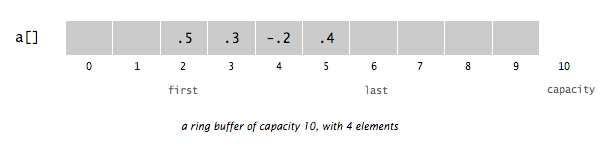
GetFirst(), getLast(), and getBuffer() should be simple getters (a.k.a., accessors) that return the value of the variables first, last, and buffer. These should ONLY be used in your JUnit tests (inside the
Cs61b/hw4/spec/hw4.md At Master · Blackcr0w/cs61b · Github
IsFull() and isEmpty() return whether buffer is at capacity and whether it is completely empty. Go ahead and write these now. You can do a little bit of testing already by checking whether the buffer created in
Is full or empty. It should always be empty since you haven’t added anything to it yet. Likewise, it should only be full if
(the number of items in it) is not necessarily the same as the length of the array. To get an accurate count of the number of items in your
Basics Of Acoustic Guitar
Into a full buffer. This is a mechanism for generating run-time errors in your program, and will help you identify bugs. (Remember: once your code is working properly, these conditions should never occur, so your program should never crash. But if you has a bug while you’re developing it, you’d like your program to crash immediately so it’s easier to debug.) The following is an example of a throw statement:
To test the value of your RingBuffer fields. You will find it useful to write a boolean function in your test program that takes in two arrays and returns true if they are equal (same length and contents) and false if they are unequal. This is what you can use to test your

Please add the following import statement after whatever existing imports you already have in RingBuferTest.java. It is paramount that you do this as our submission tests will not work without it.
Java/mp1 Fall2015/readme.md At Master · Domyao/java · Github
Again, you must follow the API above. We will be testing the methods in the API directly. If your method has a different signature or does not behave as specified, you will lose a substantial number of points. You may not add public methods or instance variables to the API; however, you may add private methods (which are only accessible in the class in which they are declared). You may also add private instance variables for data that must be shared between methods.
Class. Do not hardcode it in your constructor. Remember that proper style for static variable names is to write them in all-caps with underscores to separate words.
Function to get you started. You are not required to use JUnit testing for GuitarString, and honestly we wouldn’t recommend trying, since it requires more advanced JUnit techniques we haven’t covered in class. Eventually you may to think about cases that aren’t covered by what we provide you and add them. For now though – if your constructor works – the test we provide should at least create a string with a capacity of 10 that is initially full. The rest of the test that tics through a bunch of samples won’t work until you implement the remaining methods.
How Late Is Sallypercent27s Open Is Isn't
Reminder: none of these methods should call getFirst(), getLast(), or getBuffer(), as those methods only existed for the sake of testing in your JUnit files. You should not use any of those three functions in
Tic() should apply the Karplus-Strong update: compute the average of the first two samples of the ring buffer, multiplied by the energy decay factor (

NullPointerException – Check the line number provided in the stack trace. An object you are using in this line has not been
0 Response to "Guitar Hero Java Ring Buffer"
Posting Komentar