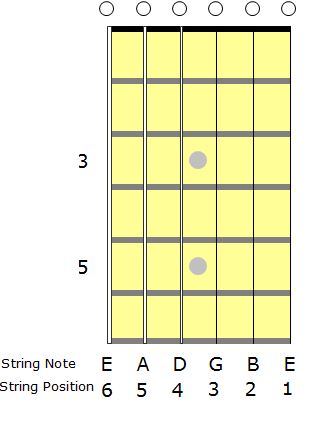
The chart below shows the notes and the string positions of the guitar. When we refer to a string as the first string that is the high E on the right side of the chart. When you are holding a guitar, the low E string (sixth string) is on the top. The notes of the guitar strings in open tuning left to right are E, A, D, G, B, and E.
When you are new to playing guitar, your fretting fingers will need to stretch to the strings and frets on the fretboard. This will seem uncomfortable at first. Your fingers are doing things that they are not used to doing. This is very normal – all guitar players start this way. This will just take some training.

Your fingers will also need to get used to holding the strings down on the fretboard. This will hurt at first-especially if you are using an acoustic guitar. Acoustic guitars have a heavier gauge string which makes holding the strings a little harder.
Bm Guitar Chord [easy]
You will just need to work through it. In a short amount of time, your fingers will develop callouses. Once you develop good callouses on the tips of your fingers, holding the chord will no longer hurt.
To hold down a chord, place your fingers on the string and the fret based on the chord chart. In this example, we are playing an E Chord. See the chord chart below.
Your thumb should be on the back of the neck of the guitar. This will make it easier to bend your fingers for a nice arch.
A Chord On The Guitar (a Major)
Place your first finger on the fourth string, the first fret of the guitar. Your finger needs to be close to the bottom of the fret, but not on the fret. Now place your second finger on the fifth string, second fret. Your finger should be in the middle of the fret with your finger arched so that it does not touch any of the other strings.
Then place your third finger on the fourth string of the second fret. See the figure below. Your hand should look like the picture below. Now, just strum down on the strings with your right hand. Congratulations – you have just played your first song on the guitar!!
You should not have any “muted” strings when you strum the chord. All of the strings should ring clear. If you have muted strings, adjust the arch of your fingers until all of the string ring clear.The A chord on guitar is very common. It’s one of those chords that pops up again and again, in all styles of music. In this free lesson you will learn:
How To Play C Major
The full name of the A chord is “A Major”, but most people simply call it “A”. In it’s full form the A chord on guitar looks like this:
(If you don't understand the above image please read our article How To Read Guitar Chordboxes In 60 Seconds. It will make everything clear!)
Playing an A chord on guitar is relatively straightforward (compared to some other chords, such as F), but it still presents a big challenge to the absolute guitar beginner.
Quick Guide To Play Guitar Chords
I tell my new students to play an easier version of A, just to get them started. This very easy chord is called “Asus2” and it looks like this:
This is a fabulous version of A to learn and it acts as an excellent stepping stone towards playing the full A chord.
Another alternative version of the A chord on guitar is “A7”. This is a relatively easy chord to play and has an interesting (and much stronger) sound than Asus2.
How To Play F Major
Remember that regardless of what version of A chord you play, you should only play strings 1-5. String 6 should not be played! Let’s have a quick refresher on string numbers:
Don’t ever be tempted to play Am (pronounced “A minor”) or Am7 (pronounced “A minor 7”) instead of the A chords above. A minor has a very different sound to A!

Here are some other cool-sounding A chords . What Type of Guitarist Are You? Take our 60-second quiz & get your results: Take The Quiz Join the world's best online guitar school 🌎 Get your own personalised guitar learning plan (customised just for YOU). World-class online guitar courses. Learn at your own pace. Community Campus & Learning Forum - A friendly community! Connect with our team & students. 😊 Beginner Song library with chordsheets, tabs and tips. (Songs suitable for all levels!) Regular live streams, seminars and Q&A sessions - Learn from world-class guitar educators. Get all your questions answered! Click here to learn more about National Guitar Academy membership Cool Guitar T-shirts 😎 Look cooler! Check out our merch: Click here to see our merch store Want free guitar tips and video lessons delivered to your inbox? Join over 250, 000 other guitar learners and subscribe to our guitar-tips-by-email service. (It's free.) We'll send you a series of lessons that will move you to the next level of your guitar journey. Learn how everything fits together quickly, easily and effectively. We share ninja tips (for instant fun!) but also timeless fundamentals that will deepen your understanding.In this lesson, I’m going to teach you eight guitar chords you must know if you’re a guitar player. Even if you already know these chords, you can still stick around since I’ll be giving you some tips to make your chords sound clean and your transitions sound smooth. If you want to learn to use these chords to play popular songs, check out these guitar lessons for beginners.
Set Hand Hold Basic Guitar Chord Stock Photo 325266866
The eight chords we’re going to look at in this lesson are G major, C major, D major, F major, E major, A major, E minor, and A minor. Now, you might be thinking that there’s no way you can remember these chords in one lesson, but don’t worry about that. You can space these out over a few weeks or a few months and take them on at your own pace.
Chord Tip: Bring your hand up to the guitar and pretend you’re holding something shaped like an apple, which helps you with your posture when making chords. Put your thumb on the back of the guitar, and make sure to relax and release any extra tension you may have.
G Major Chord: When you’re making the G major chord, you can use your first, second, and third fingers, or you can use your second, third, and fourth fingers. I encourage you to start with your second, third, and fourth fingers, and I’ll show you why in a bit. Try it, and if you find it’s too hard for you now, you can always switch.
Bb Chord On Guitar
Put your third finger on the third fret of the low E string, and be sure to come down on the very tip of your finger. Don’t let your fingers get lazy and accidentally brush against any other strings. You also want to make sure that your fingers are placed right behind the fret.

For the second note of the G major chord, place your second finger on the second fret of the A string. To finish the chord, place your fourth finger on the third fret of the high E string, and then strum all six strings. If this is feeling uncomfortable, you can make this shape with your first, second, and third fingers, but I really encourage you to use your second, third, and fourth fingers if you can.
C Major Chord:Let’s move on to the C major chord. Place your third finger on the third fret of the A string, your second finger on the second fret of the D string, and your first finger on the first fret of the B string. When you strum, leave the low E string out and just strum the top five strings.
How To Position Your Hand For Bar Chords
Chord Tip: If it’s buzzing or sounds muted, check that your fingers are coming right down on the strings. The C major chord will always be a good way to check if you’re on the tips of your fingers enough.
D Major Chord: The next chord we’ll look at is the D major. Put your first finger on the second fret of the G string, your third finger on the third fret of the B string, and your second finger on the second fret of the high E string. When you strum, leave the low E and A out, and just strum the top four strings.
Chord Tip: When it comes to memorizing guitar chord shapes, there are two things you can do to help you memorize chord shapes faster. The first one is to look at the chord when you make it and memorize what it looks like. You’ll probably be looking at the chord shape diagrams on paper or on the computer, but looking at the chord shape as you make it is a great way to help remember it. The second tip is to memorize how the chord shape feels. Look away from the chord shape and think about how the shape feels. If you try to memorize the chord

0 Response to "How To Hold A Chord On Guitar"
Posting Komentar