It’s sometimes hard to justify the expense of a bass practice amp, especially when players already own a full-sized rig for band rehearsal, gigging, and recording. In order to make the most of playing time at home, however, the thunderous half-stack just isn’t practical. Having a quality bass amp for practice is the solution.
Practice amps should be small and portable enough to cart from room to room should you want to. One of the beauties of playing at home is being able to set up and get comfortable wherever you happen to be, whether that’s your office, bedroom, living room, or dedicated home studio.
Sound is obviously important as well, and as long as you get a nice well-rounded tone out of it, it’s probably more than adequate for practice. Small amps aren’t going to push air and move low frequencies like powerful heads and multi-speaker cabinets do, but they can still sound incredible despite their size and output.
Amplitube 5 Cs
Certain amps also touted as practice/home solutions come with handy home recording features like dedicated XLR outputs so you can run direct from the amplifier to an interface. Lots of musicians record themselves as part of their practice routine, and if you fall into that camp, consider this feature as well.
Generally, the smaller the better for practicing at home. We’re talking about not disturbing neighbors, and potentially being able to play during off hours without disturbing anyone. Consider low-wattage options somewhere between 25 and 50 watts for controlled power, and speaker sizes 10″ and under. With few exceptions, we’ve included all low-wattage bass amplifiers well suited to low-volume practice at home.
The Orange Crush series has been a longtime favorite practice combo for both bassists and guitarists. The Crush Bass 25 is a 25-watt practice amp with a single 8″ speaker. Controls include a three-band EQ with a parametric mid-shaping knob, but it’s all pretty straightforward from there. Other features include a dedicated headphone output for silent practice, a built-in tuner, and an aux input for connecting and jamming along to backing tracks.
Home Recording Studio Setup [8 Essentials You Really Need] July 2023
Blackstar’s U30 is great for tone-tweakers who want the depth and versatility of their primary rig in practice format. While the hands-on knobs are relatively simple, the amp gets its chameleon-like tone-shifting capabilities from three distinct voices and onboard effects like compression and chorus. The amp also contains an aux input and an XLR/line output for direct recording.
The Rumble series by Fender is another longstanding favorite in the world of smaller bass amps. It’s surprisingly versatile, featuring a four-band EQ and three separate switches for further tone refinement. The Rumble 40 also has an overdrive section for gritty bass tones, which is perfect for heavier genres. Like many modern amplifiers these days, it includes an aux input, headphone output, and XLR output.
Ampeg’s RB-110 is a 50-watt combo with a single 10″ speaker. Visually, it’s reminiscent of old-school ’60s-style Ampegs which fans of the company will love. Sonically, it’s every bit what makes Ampeg such a renowned bass amplification company to begin with. The amp has a three-band EQ with a dedicated SGT grit section for overdriven bass tones. The RB-110 also has the obligatory XLR output, headphone output, and auxiliary input.
Recording Bass Guitar
Hartke is another beloved name in bass amplification, and though this amp is on the bigger side at 75 watts, it makes a good home practice amplifier regardless. The 12″ speaker and 1″ tweeter are enough for rehearsal and stages, but you can tame the beast enough for low-level home playing, too. In addition to the standard three-band EQ, the Hartke has a seven-band graphic EQ for more advanced tone shaping — this is a every bit an exceptional bass amp in a smaller package.
The Phil Jones M7 is a mighty combo 50-watt combo with a 7″ speaker and tweeter. Its cubic shape is unique and attractive, and its sounds back up the cool design as well. As far as controls go it’s quite simple: three-band EQ, preamp/master volumes, aux input with a dedicated level control, headphone output, and line output. For practice or even band rehearsal/gigs, this would be a fantastic amplifier.
Here we have a true practice amp in every sense. This tiny, battery-powered amplifier puts out a minimalist 3 watts from a 3″ speaker, complete with onboard overdrive and compression for additional tonal variety. Despite its size, it still has an auxiliary input so you can connect external devices and play along to get the most out of your practice sessions. If you want the ultimate in portability, look no further than the miniature FLY 3 by Backstar.

Best Budget Bass Guitars 2023
The MAX 100 by Peavey is a bit beefy by practice standards, weighing in at 100 watts thorough a single 10″ speaker. That makes it capable for band practice and smaller gigs, though, so don’t rule it out if you need an amp that more or less does it all. In addition to overdrive and a three-band EQ, the Peavey has various buttons to engage, including contour, mid shift, and bright controls. There’s also a Kosmo-C button that actually imparts harmonics in the sound for even more versatility.Disclosure: This post may contain affiliate links. If you click on a link and make a purchase, Black Ghost Audio will earn a commission.
There may be no better feeling than nailing a bassline in a recording session. On the flip side, there may be no more disheartening feeling than listening to a recording and realizing that your perfect performance was ruined by a technical recording problem. Let’s take a look at 5 tips to record bass guitar like a pro.
You don’t need expensive gear, but the type of bass guitar you use does influence the timbre of the sound you record. It’s important to match the style of guitar you use to the style of music you’re trying to create.
Best Studio Monitors (2023) For Home Recording On Any Budget
Do you need to go out and buy a new bass? Definitely not, but understanding what your bass guitar is capable of is critical. If it can’t produce the tone you’re looking for, consider renting or borrowing a different type of bass guitar for your recording session.
For example, if you take a look at this list of bass guitars, there are some bass guitars that produce funky growls, some that reduce hum and deliver a thick tone, and some that deliver the type of clarity usually associated with metal and rock music. There are also acoustic and fretless bass guitars that provide their own unique sounds.

Making sure that you use the right bass for the job will make a big difference in your recordings. Don’t shoot yourself in the foot by recording a bass guitar that produces a tone that clashes with the style of your song.
How To Record Bass Guitar At Home
Once the “Record” button is hit, all the seemingly unnoticeable equipment glitches that you haven’t dealt with yet will get captured. As you begin to mix your song, these issues will get amplified and become painfully noticeable.
Crackles and buzz can be a nightmare to edit out, so it’s best to avoid recording these issues in the first place. It’s worth checking that all your gear is configured to produce the cleanest signal possible before stepping into the studio.
You’ll want to get your bass guitar set up with minimal fret buzz, check that the intonation and tuning is correct, and that there are no issues with the internal electronics. While you’re at it, ensure that the effect pedals and amplifier you’re using aren’t producing any unwanted artifacts.
Bass Guitar Recording Methods To Enhance Your Tracks
All of your equipment connections should be made with quality instrument and patch cables. Something as simple as a poorly soldered cable can cause severe recording issues. Learn how to affordably build and repair your own instrument cables; stop spending money replacing faulty cables.

Grounding issues can create hum and buzz that permeate your recordings, but these issues are usually quite easy to overcome. The following video by Loopop demonstrates how you can fix and prevent hum, buzz, and ground loop noise.
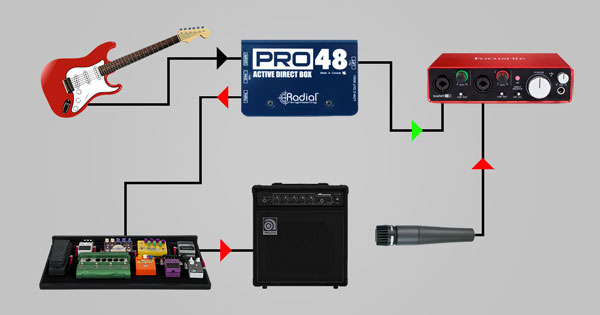
A direct injection (DI) box converts unbalanced high impedance instrumental level signal to balanced low impedance mic level signal, which allows you to run the signal over lengthy distances while avoiding noise. A quality DI box or preamp pedal will also allow you to split the input signal between two outputs—one low impedance output and one high impedance output.
Best Songs For Beginner Bass Guitarists
Running the low impedance direct output (green) into a mic input on your audio interface provides clean, effect-free recordings to work with. You can apply pedal effects and amp emulations in-the-box, which means you don’t need to commit to any particular effect chain the day you record.
The high impedance output (red) can be used to take advantage of external hardware. You can route the signal into a pedalboard and then into a bass amp. To capture the resulting sound, you’ll need to use a microphone. The great thing about recording in this way is that you can perform with your pedals instead of applying and automating effects within your digital audio workstation (DAW).
Using both outputs in combination with one another lets you capture a clean DI signal and

0 Response to "Best Bass Guitar Home Recording"
Posting Komentar