: Practice & Theory Stack Exchange is a question and answer site for ians, students, and enthusiasts. It only takes a minute to sign up.
I do not want to learn something easy now and later on find that I have to re-learn how to play the chord so that I can switch easily between chords.

Using M I A moves the I out of the way - as Justin says. It also facilitates moving directly to Amaj7, which can follow A major.
How To Read And Play Guitar Chords
Using M A P works best for me, due to being able to put I on 3rd string, 1st fret, where it won't make a scrap of difference, but is ready for the almost inevitable E chord that precedes or follows.
Some merely use one finger, in a sort of semi-barre, which covers all three, but raises enough to allow the top (thin) string to still sound.
So, as you can see, any - or probably a couple - of these will suit each person best, for reasons given. I find that a lot of players will have two versions they prefer, depending what the chord before or after was or will be. I expect my students to explore every possible fingering, and then they will decide which suits. I suggest you do likewise - with every chord shape you ever meet !
Beginner Guitar Chords
If I try to use three large fingers (1, 2 and 3), one of them ends up farther away from the fret which causes risk of fret buzz.
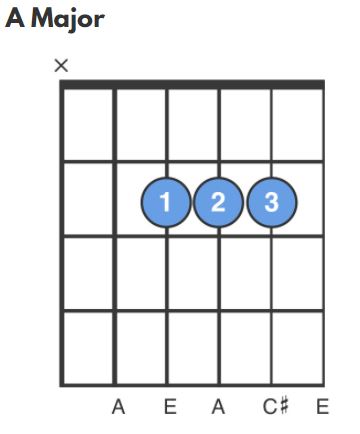
Personally, I play it either as 1-1-1 (barre-like), 1-2-3, or 2-3-4. It kinda depends on what I'm playing whether I'll gravitate towards barre-like or the more spelled-out versions. Same thing with open D.
I find barre-like forms as the most effective ways to play transposable Gs and Ds, but I mean folks often just omit some notes to play them comfortably. I do this too sometimes and I think it sounds just fine. I can see the 2-3-4 form being useful as it's similar to the spelled-out transposable A (I do usually use a barre-like form for this one though).
Chords In The Key Of A Major
If you have a guitar teacher, they may be more helpful in providing you with guidance for accelerated learning as they likely work with many new players.
From my experience, I prefer knowing a few different ways to play things. I often follow what's most comfortable/low-energy to play, but that can change depending on what I'm playing and the chord changes involved. The important things are to enjoy it, be challenged by it, and to not hurt yourself doing it. If I were to find myself hurting or straining (the wrong way), then I'd stop playing and think about those red flags.
An A Major chord, in modern popular , will most often be played as the I in the key of A, the IV in the key of E, or the V in the key of D. So this means it is most often moving to and from the Major chords D, E, G and B.
Guitar Chords: How To Progress From Beginner To Advanced Chord Shapes
Additionally, barring the D-G-B strings at second fret with index finger (1-1-1, ) whether the high e string gets muted or not, is also useful. It does facilitate easy movement to the B Maj barre chord, and also frees up a couple more fingers for augmentations. I play it this way in a lot of situations, but if I need the high e string to ring out cleanly, I’ll usually go with 2-1-3.
I like to fret open A with 213 because it prepares me for a quick transition to D without moving the index finger, and to E with just moving it back one fret. This is useful for playing in D and A.
My second favorite is to barre those notes with my index finger, leaving me open fingers to play boogie-woogie sixths, like in blues or western swing. This is good for A or E. Come to think of it, this is likely what I use most often. I often end up with a muted high E, but I already have the E on the D string and, depending on need, a low E too make it A/E.
A Minor & E Major Chords: How To Play On Guitar W/ Marty Music
I've experimented with 324, which would allow you to quickly move up with a barred A-type chord without too much work. Normally, though, I would tend to a two-finger barre fingering for this purpose.
So, my preferred A fingering depends a lot on what I expect to play next and what open strings I might want.

All the answers offer good information but I like the one by wabisabied because it offers some logic behind the answer (even though I'd disagree with the actual statement it supports).
The F Major Chord For Left Hand Guitarists
The fact is that every possible way to finger the chord serves a purpose. In choosing a fingering you need to satisfy a couple requirements: (1) does the fingering produce a good tone and (2) will it facilitate easy, optimal, movement from the chord to neighboring chords in the piece of you are playing.
There are major problems with fingerings like (1, 2, 3) and (2, 3, 4) on the classical guitar in that these fingerings tend to force the E played on the second fret of the D string to be improperly fretted. Ideally, one should try and fret the note with the finger close to the fret that defines the boundary condition for a string fixed at two ends. It is a common misunderstanding that you can place your finger anywhere in the space between two frets to play the note defined by the higher numbered fret. This is not true. What happens when you finger the note too far back is you have a string that is free to slide on the fret that defines the note. This can cause severe buzzing and a weak sound with poor tone. This can happen on any guitar, electric or classical, but I find that the issue is very noticeable on the classical. The issue is exacerbated by the fact that the D string is wound which makes the buzzing more severe. In contrast the fingering (2, 1, 3) allows one to pinch the E on the D string right up to the fret. The A on the G string will be fretted slightly far back but more towards the center of the space between the frets.
With a little practice you might be able to correct the issue mentioned above using a fingering like (1, 2, 3) or (2, 3, 4) but there are other considerations. In moving from one chord to another you want the movement to be easy, smooth and, if you care about it as many classical guitarists do, avoids squeaking or scratching noises. You want to be able to release the strings (without completely opening the hand) and generate the new chord form quickly. As several answers point out this is facilitated by different fingerings for different progressions. A common movement is A --> E7, or I --> V7, and a common fingering for the E7 is (2, 1, 3) on frets (2, 1, 3) of the (E, G, B) strings. As you can see this is the same ordering of fingers as the (2, 1, 3) option for the A chord. So the movement allows you to keep finger 2 planted and 1 and 3 can simply slide back and forward by a fret. This is an optimal fingering for this movement. By the way, this implies that one might finger the same chord 2 or more ways in the same piece of and we often do.
Bm Guitar Chord [easy]
Other considerations are physiology, e.g. if your fingers are too large you may need to experiment with alternatives or find a way to get optimal movement and clean sound other ways. But the take away is that there is more than one right way to play all chords and the motive behind the choice is motivated by the two points made in the beginning of my answer (1) clean tone, and (2) optimal movement to other chords.

By clicking “Accept all cookies”, you agree Stack Exchange can store cookies on your device and disclose information in accordance with our Cookie Policy.The A Major chord is one of the most common and popular chords on the guitar. The open A chord is one of the first chords that most guitarists learn, and it has been used in countless songs across many genres.
The instructions above are step by step instructions for playing the most common A Major chord shape, which is the open chord A. These instructions can actually be super helpful when you feel like you’re interpreting the shape incorrectly. By going through the A chord instructions step by step, you can verify that you’re playing the chord correctly.
How To Play The B Chord On Guitar
The A chord can be played as a barre chord by playing a root 6 barre chord shape and starting on the 5
Most of the time, when we play the A chord, we play the standard shapes, such as the open position A and the barre chord shapes. However, learning the
0 Response to "Play A Major Chord Guitar"
Posting Komentar